What Is AEO — And How Is It Different From SEO?
Search behavior is changing. Users increasingly expect direct answers, not lists of links. As AI-powered search experiences and voice assistants become more common, content strategies are evolving to match.
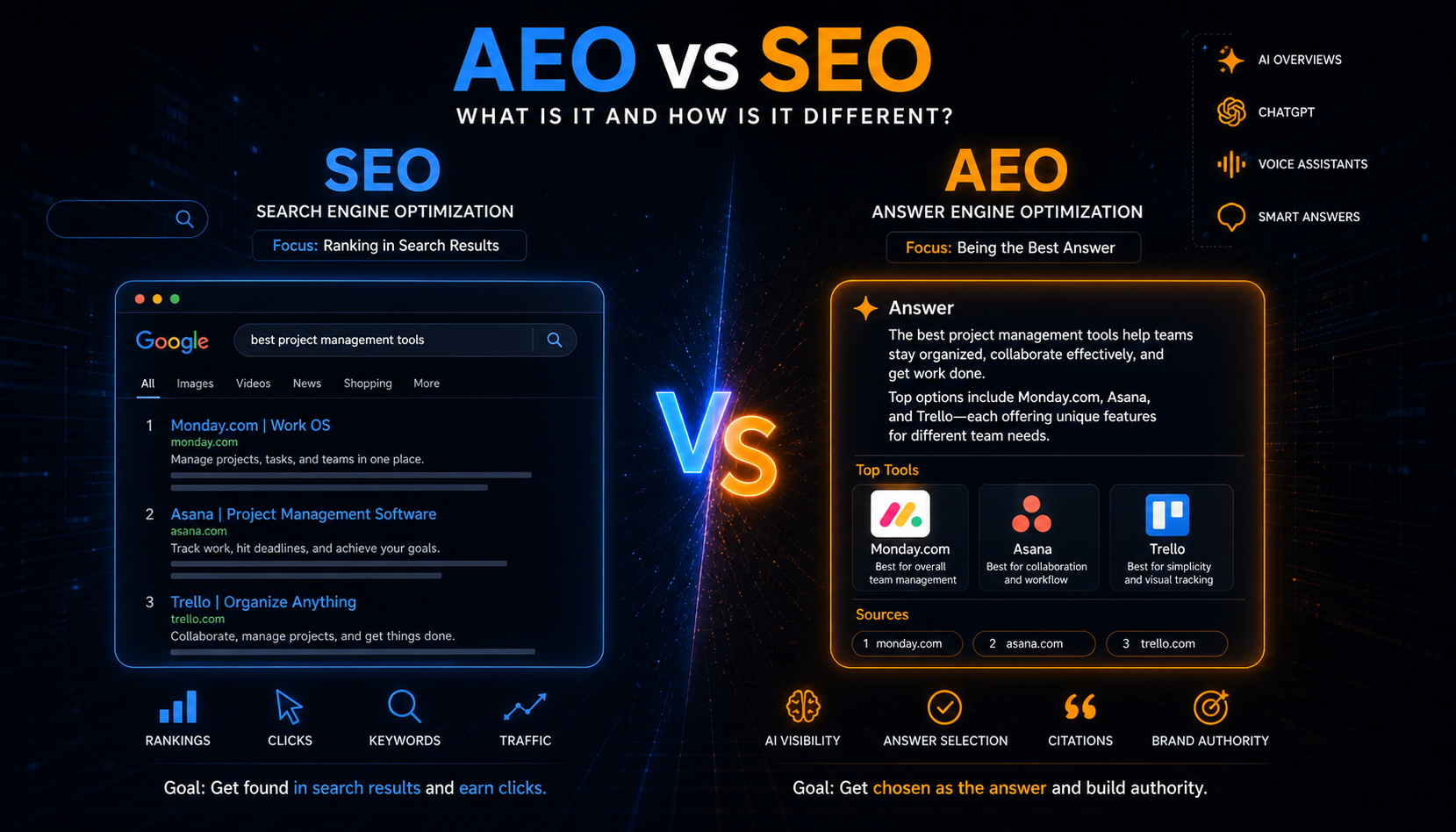
Search behavior is changing. Users increasingly expect direct answers, not lists of links. As AI-powered search experiences and voice assistants become more common, content strategies are evolving to match. This shift has introduced a complementary concept to traditional SEO: Answer Engine Optimization (AEO).
SEO: Optimizing for Search Rankings
Search Engine Optimization (SEO) focuses on improving a website’s visibility in traditional search engine results. The goal is to rank relevant pages higher so users click through to the site.
- Keyword research and topical relevance
- On-page optimization (titles, meta descriptions, internal linking)
- Technical performance (page speed, mobile usability, crawlability)
- Authority signals such as backlinks
SEO remains essential for discoverability and long-form engagement. It assumes that users will review search results and choose a link to explore further.
AEO: Optimizing for Direct Answers
Answer Engine Optimization (AEO) focuses on structuring content so AI-driven systems can extract and present clear answers directly to users.
- These systems include:
- AI-assisted search results and summaries
- Featured snippets
- Voice assistants and conversational interfaces
AEO prioritizes clarity, accuracy, and structure over ranking alone. Instead of optimizing pages primarily for clicks, AEO optimizes information so it can be reused reliably by answer engines.
Key Differences Between SEO and AEO
| SEO | AEO |
|---|---|
| Primary objective | Provide direct answers |
| Optimization focus | Pages and keywords |
| Typical outcome | Website traffic |
| Content style | Clear, concise, and explicit |
| User interaction | Often no click required |
Why AEO Matters
Many modern search experiences now provide answers directly within the search interface. This reduces click-throughs but increases the importance of being cited, summarized, or referenced as a trusted source.
AEO helps ensure that when users ask questions, your content is eligible to be used as part of the answer — not just listed as a possible option.
Conclusion
SEO and AEO serve different but complementary purposes. SEO helps users find your content. AEO helps your content be used to answer questions.
Organizations that invest in both are better positioned for how search and information delivery are evolving.